Monday, August 12, 2013

Revisiting a Dark and Distant Fantasy Part II: Fiat Plumbum

And on the third day the Gamemaster said: "Let there be lead." And He brought forth lead miniatures in all their varieties: man and beast; elves, orcs, and dragons; dwarves, halflings and lesser creatures. Even an artillery piece or two.

But today we're just going to talk about men. (And anyone who dismisses halflings obviously hasn't been on the other end of a sniper scope from one. Or within throwing distance, really. I want a baseball team made entirely of halflings. We'll win every game.)

In Part I we left off with discussions of plastic miniatures. My first experiments with heavy metals were relatively tame as they go. I painted them up and left it at that.


Modifications, such as they were, were little different from what I was occasionally doing in plastic to "wolf" things up:


Okay, the plastic guy has some small alterations beyond wolfing. But if I recall correctly that miniature was one I acquired from Ben. I modded the bolter and added the pelt. Ben had already posed it. For some reason I kept it though. But back to lead . . .

One subtle but significant modification is visible in the next two pictures:


Can't see it? It's subtle. Let's try one more . . .


Whad'ya think? There it is. I started drilling out the barrels on my guns. Plastic, lead, or whatever else I might have used. It's a small thing, but I like it. Saw it in White Dwarf and I was hooked.

When the Space Wolves characters came out I had the fantastic idea, absolutely fantastic, that my command section should be mounted on wolfback. Wolves the size of draught horses. Pretty silly, honestly, but I did it. The results were mixed, but I was all of twenty or twenty one at the time. Still learning.


That was the beginning of my experiments with sculpting. Still hadn't discovered kneadtite (or green stuff, if you prefer), so everything was rather crude. But the concept wasn't terrible. I find it might almost be worth updating. Shortly after this I started building an orc army and got a little more serious about conversions.

To the curious, the mage-advisor (*cough* runepriest) started as a chaplain, lost his head, gained a plastic beak, a wire and plastic staff not visible from this side, an assortment of Squadron Signal green putty runes, and a crude home-made wolf head. The CinCWolf, Leman Lord Geri, has plastic legs, a rough-rider torso (apt, no?), a plastic head modified by the addition of a wolf-snout, an orc sawblade coated in putty and sculpted into a chainsword, a spare Freki's head on his helm, her tail on his sword, a plastic power-first, a wire necklace with plastic-sliver teeth, several crude putty gemstones, and a paper cloak with a homemade wolf pelt. While I still have uses for Squardon Signal's green putty, It's not the material I'd use for sculpting anymore. I used it then as I had it lying about, but now I'd go for kneadtite or possibly milliput. (Still have to give the old standby a try. I'm learning to like the "green stuff," but the "white stuff" supposedly has advantages for some projects. Possibly of the largish sort I sometimes enjoy.)

In the next edition I'll show you my very last conversions before jumping off the bus and moving to 1/2400. Of course, I seem to be back aboard, so maybe I'll try my hand at it again now that I've learned a thing or two. And tell me if you spot this evening's easter egg modeling project. Again, thanks for listening. It's a journey, but we're getting closer to the end.

Sunday, August 11, 2013

Revisiting a Dark and Distant Fantasy Part I: Early Imperial Plastic

40,000 years in the future used to be a fairly grim place. Kind of a dirty classic steampunk. Then it got bright and all comic-booky heroic and I decided the light bothered my eyes so I left. Mind you, I never got rid of my toys, so the door was always open. To be honest, I guess I'd just pretended I'd left: threw some blankets over the windows and retreated to the basement. (To crib shamelessly from my friend Z, who lives the dark and dangerous steampunk life every day.)

While the apocalyptic destruction of the great gaming citadel is ongoing, I've decided I might as well admit I'm still here and come out and play with the bones a little. They're good bones. Bones with character.

I first met the Space Marines in a friends box set of the then ubiquitous "beakies." I hated them. Everything was exagerated. The models were crude and poorly detailed. They didn't fit together well. The plastic was some kind of harder grade of styrenesque something that didn't bond well with standard hobby glue. In short, they were plastic models from people that had no real clue how to make plastic models. But after I bonded with them for a little while . . . (Not literally people! I didn't use CA glue then.) . . . after I'd had some time to grow comfortable with the aesthetic I realized they had some character and this was an arms race I could join. After I read my friend Ben's Rogue Trader I was hooked. I could modify things. There were models that looked somewhat more elegant. I had some ideas.

So I bought my own box of beakies. When my friends bought multi-meltas and heavy bolters and all those fancy guns I, being on a budget then, hacked and slashed with the bits I had lying about and made my own special guns. For several years my beakies were well equipped but with something of an odd-lot look about them. Later, when I started to buy lead I found this unsatisfactory and most of the conversions ended up in the repaint/repair bin, from whence I dug these:


Everything from fishing weights to the drive shaft from a pickup truck model made it's way into the arsenal. There's also the grip from a motorcycle, sprue, German clips in large calibers, and folding fin aerial rockets. Or at least pods to carry them. Lots of model parts. I like styrene. It's good to have some sitting about. I always worry I'll run out of interesting parts but I truly never do.


None of these are in their original paint, but they're from the first couple of years. By the time of the last one I was beginning to get just a little more bold. You might see that I sliced and diced some lead in the service of a very crude conversion. He was intended as a chapter commander in the absence of the original great wolf himself. (Which figure I owned but couldn't really toss onto a battlefield.) While this miniature wasn't particularly successful, some of the techniques I tried turned out useful later.


Another technique I was slow to learn was stripping. This fellow is an example of what came out of the repair bin for a repaint. It's perhaps obvious that the stripping was accomplished with a hobby knife, but in this case I almost like it. The thick paint and bad strip job kind of give him a nice battle-worn character. He's probably due up for some repairs, but this gives you the flavor of what I did. All in all, I'd say it's not too bad for an eighteen-year-old kid. The banner is the usual paint and paper, but I think the pose, the rubber band straps, and the putty wolf's tail were nice touches.

But enough of soldiers. Given that I started out with plastic airplanes maybe it's not surprising that my army was a little more armor heavy than most:


Of course, I've never met a military model that couldn't be improved by a little cutting and pasting, or even smacking about with a ball-peen hammer. The lead Predator has had the hammer technique applied to the track guard. The small piece of track is salvaged from a converted Rhino that you can see with large red crosses in a previous post. The camouflage netting is nylon screen. More hammer work and some possibly identifiable bits from more recent kits can be seen on the leftmost tank in the second picture. In the background are an old-school Whirlwind that was visible in the previous post and a Razorback that was not. (Not having been released yet and all.) The Whirlwind makes use of a conversion from an issue of White Dwarf. I cut up a large square base for the rockets (and still have baseless dreadnaughts as a result) and used some leftover bits from my Predators for the rest. The bottom was the big angle door front piece. the top was the eagle plate.

When I picked up the land raider you see below I found all this lovely empty space inside. It had a nice floor, some couches, hatches and doors you could leave unglued, but no place for a driver to sit. (And no room elsewhere in the model that couldn't be seen through that door.)


A dive into my parts bin fixed that. I've begun to forget what some of the particular bits are, but there are pieces of a visible nuclear submarine model, chairs from a German flak cannon, a wheel from a Panzer IV I think it was, an ammunition drum, a harness from a dorsal turret . . . parts. Spare parts in assorted scales repurposed to become consoles and controls. I'm still relatively pleased with the result twenty years later.


And if you want some really intense conversion, try this on for size . . .


He's beginning to show his age, Eddie is, but he's still a sight on a battlefield. He uses guns from G.I. Joe toys, electrical conduit, a cockpit from an A-10, sheet styrene, wooden dowel, paintbrush handles, a barrel from a predator, German ammo lockers, British drop tanks, the bones of two or three beakies, the flight console from a B-17 and I believe the engineer's console from a B-29 . . . and lord only knows what else. Fun stuff. I've actually used him in a battle once. Try this one on: he lost. (My friend Ben had two. Ed was a little overmatched. But I gave as good as I got.) Oh yes: if it wasn't obvious Ed started life as a vinyl ED-209 model. I have a toy star wars walker sitting about for use one day in the future. Maybe.

In Part II I talk a little about my experiments with lead and wonder where those extra brain-cells went.

Saturday, August 10, 2013

How I got myself into this . . .

Once in a while people ask me how I got into naval wargaming. The answer is a little complicated, but here goes:

I grew up on stories, models, and games. My grandfather, who served in the First Marine Raider Battalion, was at a stage where he was occasionally telling war stories when I was young. Most often the funny ones and not the ones involving honest to deadly fighting, but once in while those came out to. And the sword, medals, and Japanese flag were story enough on their own.

Add to this a father who was quite interested in World War Two. I was raised on Sunday reruns of Hogans Heroes and Tora! Tora! Tora! And of course dad was an avid model railroader and occasional aircraft modeler. He built a few plastic aircraft with my brother, sister, and I when I was quite young. When I was in middle school I began to build them on my own, and promptly got into a miniature arms race with a neighborhood friend. We counted coup in rare Airfix, Italieri, and Fujimi kits and in sheer numbers of Monogram and Revel airframes. By the time I graduated I'd guess I had fifty or more and Ben maybe half again that. (He always had a larger allowance than I.) You can get an idea of the scope of the collection in the background of this aging (Kodak instant) photograph:


Of course if you have models you have to sometimes do fun things with them:


If I can find a way to scan disc negatives I'll add one or two more to the bunch later. (There's a cool one of which I cannot find a print.) But moving on . . . 

Even on vacation I couldn't quite avoid the modeling bug.


This may not look like much, but it's a crude scale model of a town I'd sketched out in some detail for a role playing game I was in. Later on that town became a kingdom and that kingdom a world, which I suppose I ought to write about sometime, seeing as there's art and it is thus germane to this little kettle of creativity. But this is an aside for another day. Instead let me take you to the a-historical distraction that brought me to the world of formal wargaming. And models small enough to fit several into the palm of your hand. This too is an aside, but it's the one I want to get to today.

Right. So I had an arms race with my friend down the block. Well, one day he and his brother (also a friend) brought home some odd little plastic science fiction soldiers. I hated them. Really hated them. And then a few weeks later I bought some of my very own and stayed hooked for the next dozen years or so.


Oyez, oyez, I found myself sucked into the dark and stormy world of psychic monsters, dead emperors, and overstuffed beefcakes in three meters of composite (tactical dreadnaught) power armor. (Or should I say armour?)

The world known to those of us silly enough to know it as Warhammer 40K. (tm)

Yes. I was addicted. Might still be, though I just don't care for what they've done to the place in the last twenty odd years. But that's another story. This is me admitting that I still have most of that stuff. (Though sadly not the Land Raider Spartan seen in the fifth picture. But I think I know where it is. Could even make a new one with a little time and expense.) [Editorial Update: I do have the Spartan., or to be more accurate its bones. Forgot I'd reacquired that.]

So yes, those 40K pictures occasionally popping up along with music in earlier posts are in fact mine. And . . . I've bought some more and begun painting it again lately. Some were in trade for a painting commission, to be fair, but others were bought on our favorite e-commerce site for buying overpriced used jun . . . treasures.I'll take the liberty of putting the results of both the commissions and the recent purchases into another post, which should be along shortly. But back to the process . . . 

So that got me into wargaming. You can see an actual game unfolding on the lawn. As I recall it didn't go terribly well for the defenders. Some twenty years later I was teaching music at a small liberal arts college in Marshall Missouri when a colleague decided I really needed to watch the new Battlestar Galactica. I'd been thinking about wargaming and miniatures again anyway, as I'd just started painting a Squat army I'd acquired many years before. (Really should get some pictures of that one of these days.) And BG Mk. II put me in the mood for carrier combat, which naturally draws one back to the exploits of the "Big E," who inspired the "Big G." ("Big Gal," maybe? Every good ship deserves a bad nickname. Galactica shouldn't really be any exception. "Galactigator" is a little awkward so I'll go with the "Gal.")

And there you have it. Cylons lead inevitably to Midway if you follow the right path. Thus did I get into naval wargaming. And in case you wonder, tiny little ships aren't really any more economical now than tiny little science-fantasy soldiers were then. I love miniatures wargaming, but I think the hobby does itself a disservice when a (fancy) model two inches long costs about as much as (an inexpensive) one twenty inches long. Still . . . navies require fewer ships than armies require soldiers so it's not so extravagantly expensive. Just more than you want when you decide to build fleets big enough to refight Leyte Gulf or Philippine Sea. Thanks for listening. Come back later and maybe there will be more.

(P.S. The decoration on the side of the B-17 is not a decal, for the curious. Good luck finding that decal in the late eighties. But that's what every sixteen year old boy wants on his B-17, so I painted it myself. Came up with a novel process to draw it on paper and transfer the outline onto the model so I could paint from that. Ought to revisit that process. It worked fairly well.)


Tuesday, May 14, 2013

A bit off topic but oh so important . . .

Here's a little photo-essay that explains a few things.


(The baby is unrelated. Well, not unrelated, exactly, but not ours.)


This is a little overdue, but hopefully it gets the point across. Thank you.

Saturday, May 4, 2013

Tenno Junyokan Banzai! Tenno Senkan Banzai!

Long live the big boys! Long live wagons! Long live guns the size of steers!

But first, God bless the little children:


These are just the sorts of things Japan could have really used more of. Viking Forge sells them as the Etorofu class, but they serve almost equally well as the preceding Shimushu class, for which I have chiefly used them. Collectively the Imperial Navy called these two classes "Type A Kaibokan." These small but handy escorts were upgraded throughout the war, eventually boasting six depth charge projectors, a trench mortor, and a pretty decent sonar suite on a displacement of just under nine hundred tons. They weren't quite Flowers in terms of ASW, since Japan never had anything quite as nice as Hedgehog or Squid, but they were moving in the right direction, albeit with a multi-purpose military hull that cost a little too much. As the war drug on Japan began to realize that they really needed more of these things cheaper and with more and better ASW projection, so they simplified the hull dramatically, but it was a case of too little too late. If Japan had invested in mass producing cheap versions of these from the early forties the submarine war might have been a somewhat more difficult proposition for the U.S.

All or nearly all of Japan's prewar escorts suffered to some extent from one particular problem: all were capable, multi-role ships that cost too much to be economic ASW platforms. The Type A Kaibokan described above are no exception, but the next two classes might be even better examples.


These two are the torpedo boat Otori and the small minelayer Natsushima, both from Panzerschiffe. Both were intended for convoy escort, but both were also outfitted for additional roles: the Otoris had a significant anti-surface capability in the form of several 4.7" deck guns and a triple torpedo mount, and a thirty knot top speed. Natsushima and her sister Nasami shipped over a hundred mines on a five hundred ton hull. The Otoris in particular might well have been very capable ASW escorts had they dispensed with the torpedoes, most of the deck guns, and a large portion of the powerplant. As it was they probably had too much equipment on too little displacement to be entirely satisfactory, and they surely tried to do too many different things. I suspect some of this stems from the same Japanese preference for a few very capable ships rather than many less capable ships that is so evident in major combatants. If you're planning to fight a conventional war with a wealthier opponent this makes some sense. If you need to defend against asymmetric or economic warfare (or both in one submersible package) it doesn't really work out.

Speaking of submersible packages . . .


The above two submarines are different models of the same class from different manufacturers. For reasons that may be self evident I have not used them as such. At the top is a conversion of a C in C miniature, which they market as I-19. Below is Panzerschiffe's I-15. Both of these boats were B-1 types. Since C in C miniatures virtually always seem just a little smaller than their competitors (they claim that theirs are the correct scale) I have used their boat as a slightly less bulky C-1. To do so I stripped off the hangar and catapult track, cut the deck gun off and replaced it forward, and added a guard at the bow for the forward anchor of the radio antenna. I decided to use the Panzerschiffe model for I-19 since the GHQ search plane made a much better visual fit on the larger model. The catapult track is broad, making it easier to mount the aircraft, and the hangar is large enough to look plausible if quite cramped. I made surprisingly few alterations, all considered. I did add a crane, but since this is collapsible it would be quite excusable to leave it off. I changed out the deck gun for one I built up out of stock to make it look a little lighter, but again, this isn't vital. The only alteration I considered truly necessary was the addition of a pair of periscopes.

Among my new-build Japanese destroyers are these two FubukisFubuki and Sazanami.


Both of these ships were quite active in the early war and both were the veterans of many battles in the East Indies, the South Pacific, and ultimately Sazanami of Coral Sea and Fubuki of Midway. Both are Panzerschiffe models. The paint is somewhat speculative and a little inexact, but attempts to portray the fact that different Japanese naval arsenals used different paint formulations resulting in quite different shades of grey, with Sasebo's being darkest and Maizuru's the lightest.

Just when I think I've got a handle on Japanese destroyers I learn that they built a quick-firing behemoth during the war as an AA escort for their carrier fleet:


I first learned of the Akizuki class in the "Imperial Council" thread on the World War 2 Forum, www.ww2f.com. Somehow I had repeatedly overlooked them in my previous researches. They're surprisingly large even for a navy known for building large and capable destroyers; weighing in at 3,700 tons fully loaded. With eight quick firing 4" DP guns for a main armament these must have been fearsome AA escorts indeed, almost an AA cruiser. I've used yet another Panzerschiffe model to depict them, albeit with the usual added masts.

But I said I'd also built a few heavies. Admiral Takao, this one is for you:


Years ago, when I built Atago, I rather fell in love with Japanese heavy cruisers. These were large, fast, sleek ships with a tremendous punch and the Takao class, with their enormous flag bridge, had an especially menacing and almost modern aspect. While Atago still looks alright, I've learned a lot since then and I put all the lessons to work on Takao (and Nachi.) Both of these are Panzerschiffe models, but I've added quite a lot of detail. You can see masts, rangefinders, secondary gunbarrels, breakwaters, aircraft cranes, anchor chain, and anchors. Most of these are fabricated from simple styrene stock. For anchor chain I use the smallest cylindrical stock I can find and crush it in a pair of pliers to give it a corrugated surface that looks chain-like from a distance. The aircraft are GHQ details and the ship's boats are C in C. In order to get the appearance of boards I run deck brushstrokes in parallel, painting a light wood color over black. I typically allow a little black to show through this second coat. When you drybrush a light color across the direction of the brushstrokes it actually makes the "boards" pop out just a little and it can be quite convincing.

The last new ship I'll discuss today is Ise, which you will see in the forground of this picture:


This is a nice study of what can be done with a Panzerschiffe model and some patience. For comparison I've placed Ise in front of a C in C Kongo I painted up as Kirishima several years ago. When I first bought the C in C miniature it left me somewhat dissatisfied with my (increasingly large) collection of Panzerschiffe miniatures, but I have more time than money, so the best solution for me was to find a way to make what I had look better. That's when I started trying to find a way to add deck details. It's taken a good couple of years and a lot of practice, but I think you can see that it's paid off. I think my simple Panzerschiffe Ise looks entirely presentable next to the C in C Kirishima. (To which I have also added a mainmast, to be completely fair. I haven't been content to build a model as-is in years.) Ise had the complete treatment described above plus radar. Apparently she was the first ship in the whole of the Japanese Navy to carry air search radar. A very handsome ship, if I do say so myself.


Thursday, May 2, 2013

Minor American Combatants

Minor combatants are often amongst the unsung heroes of naval warfare. (They're in good company with auxiliaries and merchant vessels. Everyone likes solid teeth in their military, but without a good logistical tail the teeth have very little bite.)

I've long been interested in minor combatants and lately I've begun to find more sources for off the shelf models of these. Most notable amongst these is the Seabattles line which is available in the U.S. as recasts from Viking Forge. While the models from this line aren't quite as crisply cast as GHQ, the models have a lighter, more delicate appearance and look fantastic painted up, and since most are one piece castings even inexperienced modelers will enjoy them. I bought two packages in the U.S. range: the Treasury class cutters and the USCGC "Party Pack."

The first contains four models that look something like this:


This depicts them more or less as they looked before the war, so I felt some changes were needed to militarize them. As the war grew longer the Navy added more and more armament to these lovely little ships, but the first round primarily saw the addition of an improved AA suite and some additional ASW weapons. I started with USS Ingham, which was a little less modified early war than some others. I worked from this photograph I found on the Historic Naval Ships Association website:


This is apparently a modified version of what was called the "Thayer" system of deceptive camouflage. Thus far this scheme is unique in my collection. If I understand the early war changes correctly, she had one of her 5"/51s landed and gained 2 smaller mounts forward (possibly surplus 4"/50s), a pair of smaller mounts aft (possibly surplus 3"s), two autocannon/machinegun grade mounts, and some ASW astern. I didn't attempt to depict the ASW, but you can see my changes to the AA and surface fit. [Thanks to Carronade on WW2f for the corrections.]


Further, I added the mast, the searchlight platform, and the bedspring antenna according to the usual crushed styrene stock method.

The next ship was much more satisfying:


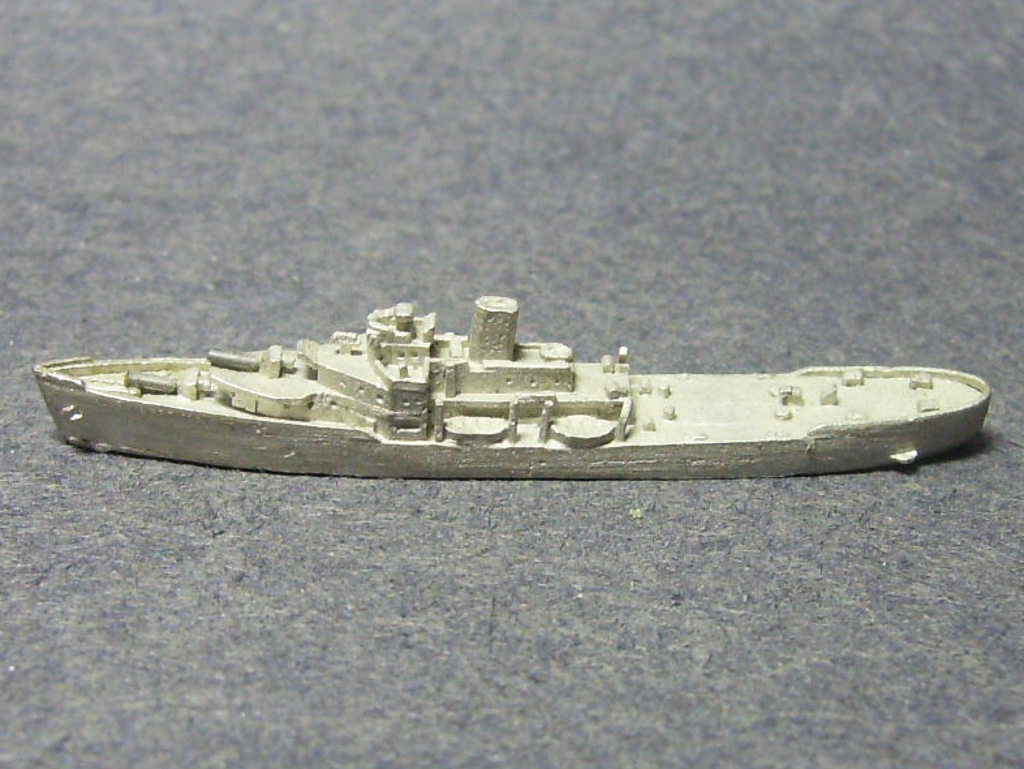
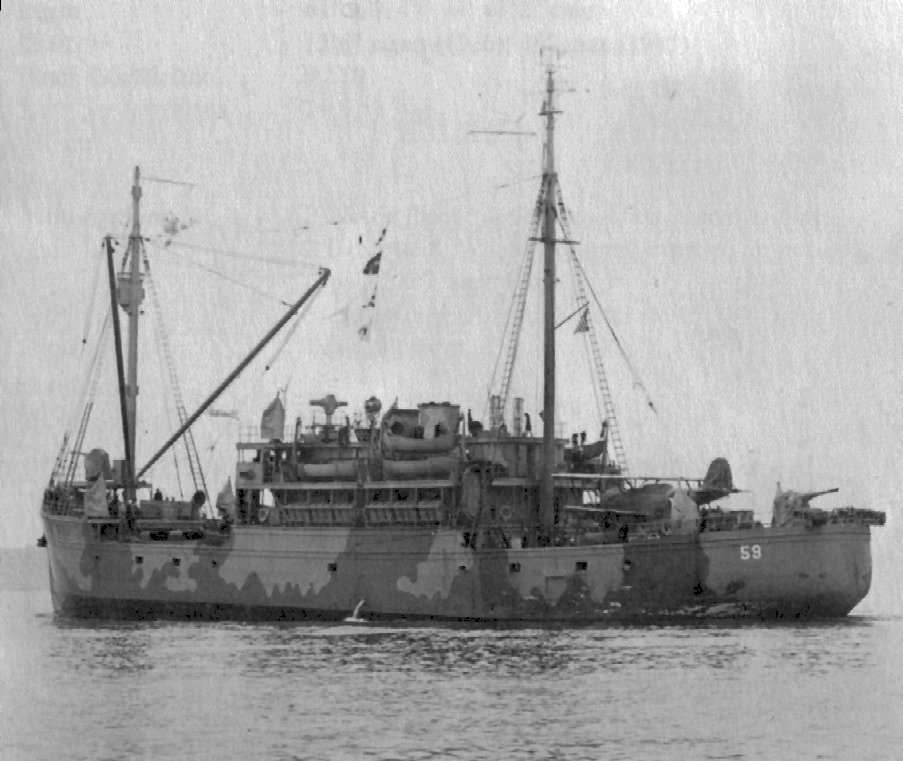
This one took some real research. She came from the "Party Pack." One of my only complaints with Viking Forge thus far is their refusal to sell the other cutters in their inventory individually, selling them only as a random selection from a pile of prewar, wartime, and postwar cutters. (If I were going to be uncharitable I might guess that all the cutters accidentally ended up together and rather than try to sort them back out it was decided to shake up the box and sell them in "booster" packs a la Magic the Gathering [of Your Money.]) It was on me to figure out quite what I had. Careful research helped me identify some of them, but only after I found a complete Seabattles catalog saved in my files, lord knows where I found that, was I able to confirm some and correct the rest.This turns out to be USS Northstar. (IX-148 to the Navy, WPG-59 USCGC Northstar to the Coast Guard.) And I was absolutely endeared by the dainty little ship with the SOC aboard aft. I attempted to depict her as I found her in this picture from NavSource:


Last but not least is a pair of tugs I acquired from Panzerschiffe:


The dark blue one wearing MS-21 depicts USS Vireo, which attempted the rescue of USS Yorktown. She was built as a Lapwing class Minesweeper but later reclassified as a fleet tug (old) ATO-144. The nearer ship, wearing MS-22 graded paint, depicts USS Navajo, AT-64. Navajo survived air attack and numerous tricky tows in the Guadalcanal campaign only to be lost to a torpedo from I-39 en route between Bora Bora and Pago Pago in the Spring of '43 far behind the front lines.

These two models required a bit more work than the Viking Forge acquisitions, but the end result is fairly satisfying. All of the above might call at a South Pacific harbor like this one:


But discussion of that can wait for a later post. Next up: Imperial Japanese tiny terribles (and a few heavys.)

Wednesday, May 1, 2013

The Dutch

Among my other recent acquisitions you might recall mention of a modest Dutch force. This force entails most of their forces from the East Indies station. (All of the cruisers and half the destroyers.) It's a modest forced, but nevertheless one worthy of consideration. All of these are Panzerschiffe models which I detailed. I began with De Ruyter.


As I have mentioned before I try to use Midway as something of an anchorpoint, depicting ships more or less as they appeared as close to mid 1942 as I can get them, thus I attempted to depict De Ruyter at about the time of her loss. In this I failed rather spectacularly. I have several reference books to hand, including one specifically discussing camouflage, and I habitually refer to several websites. Initially I could find no photographs of De Ruyter later than the mid-thirties and no reference to camouflage. Later on while researching Tromp I learned that the Dutch ships were ALL camouflaged, generally in a similar pattern, and had the decks darkened with a crude oil stain. Naturally I learned all this later. Eventually I even found a picture at the Australian War Museum. I may eventually correct it, but she stands in her peacetime paint for now.

Not so Tromp and Java:


I did find art depicting Java and several photographs of Tromp in camouflage. For now, I think the former two make a very nice division.

Particularly accompanied by these two Admiralen:


These two depict Kortenaer and Piet Hein, though all four are painted virtually identically. (All are roughly based on a picture of two unidentified Admiralen. A second picture of Witte de With appears to show a similar camouflage scheme, but is much less clear.) Again, the paint evolved as I worked, since I learned of the deck stain partway through my destroyer run, and I also failed to note the false bow wake at first. All in all, however, I'm fairly pleased. A little work will correct the problems, but for now they add variety, which is always good. I've yet to see a photograph of a large formation where the paint schemes were truly uniform. There are some rather famous pictures of large fleets U.S. warships in MS-3x dazzle variants, but even in the midst of these some older MS-21 Navy Blue creeps in.

Anyway, there we have the Dutch. Next we will look at some lighter U.S. combatants before we head on to the Japanese and ultimately the few heavies that crept in.